🏗️ Aroeira

Planning insulation, wall renovation, tiling and conversion

📍 Charneca da Caparita, Lisbon

Project structure

1st façade
Plaster renovation, filling cracks, ETICS insulation (EPS) on side walls + front wall Lawn · Front and rear only painted
2. Roof
Surface strip-back and reconstruction of roof including waterproofing
3. Balconies
Surface strip-back and reconstruction of 4 balcony areas (1st floor) including waterproofing
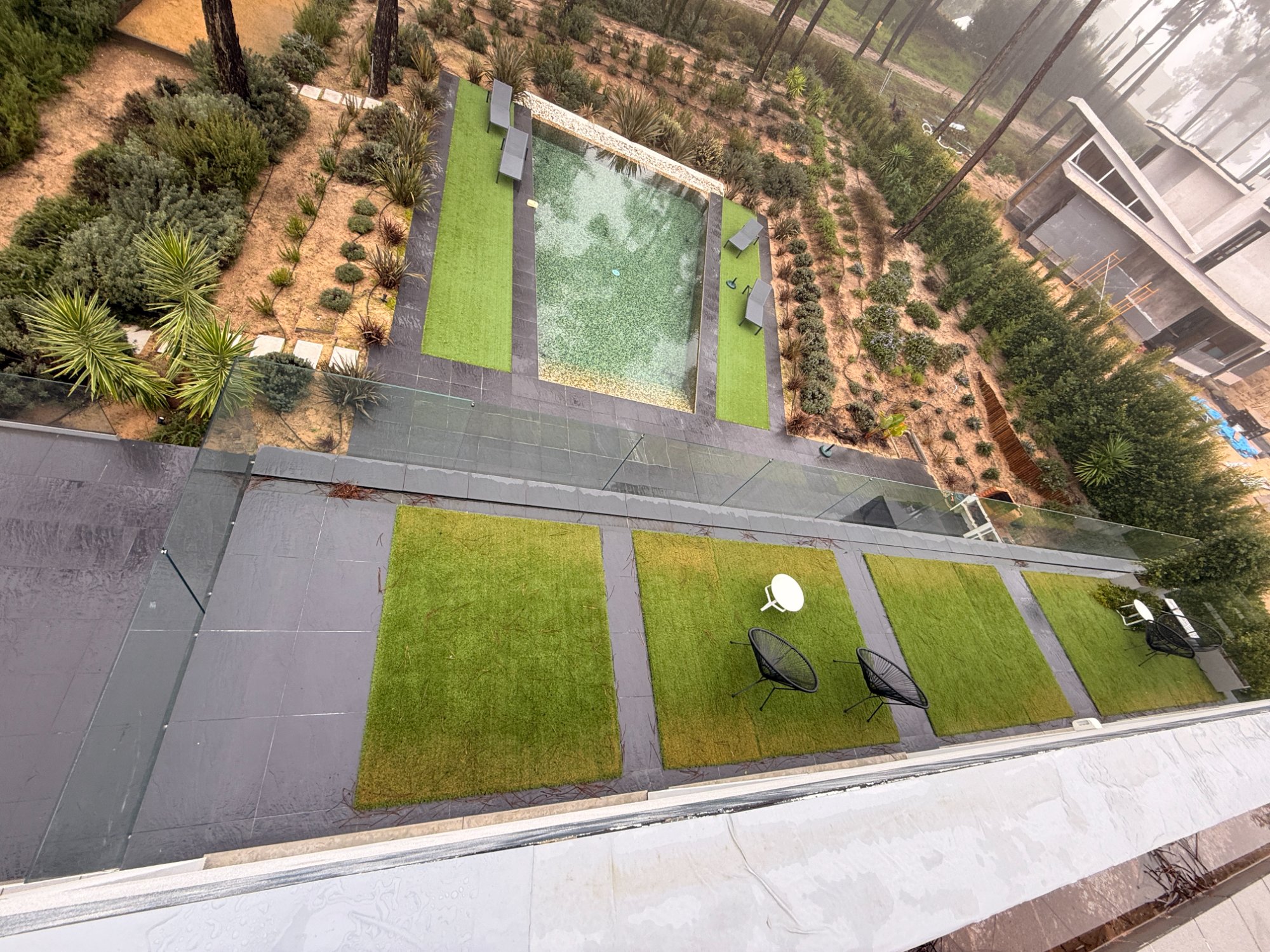
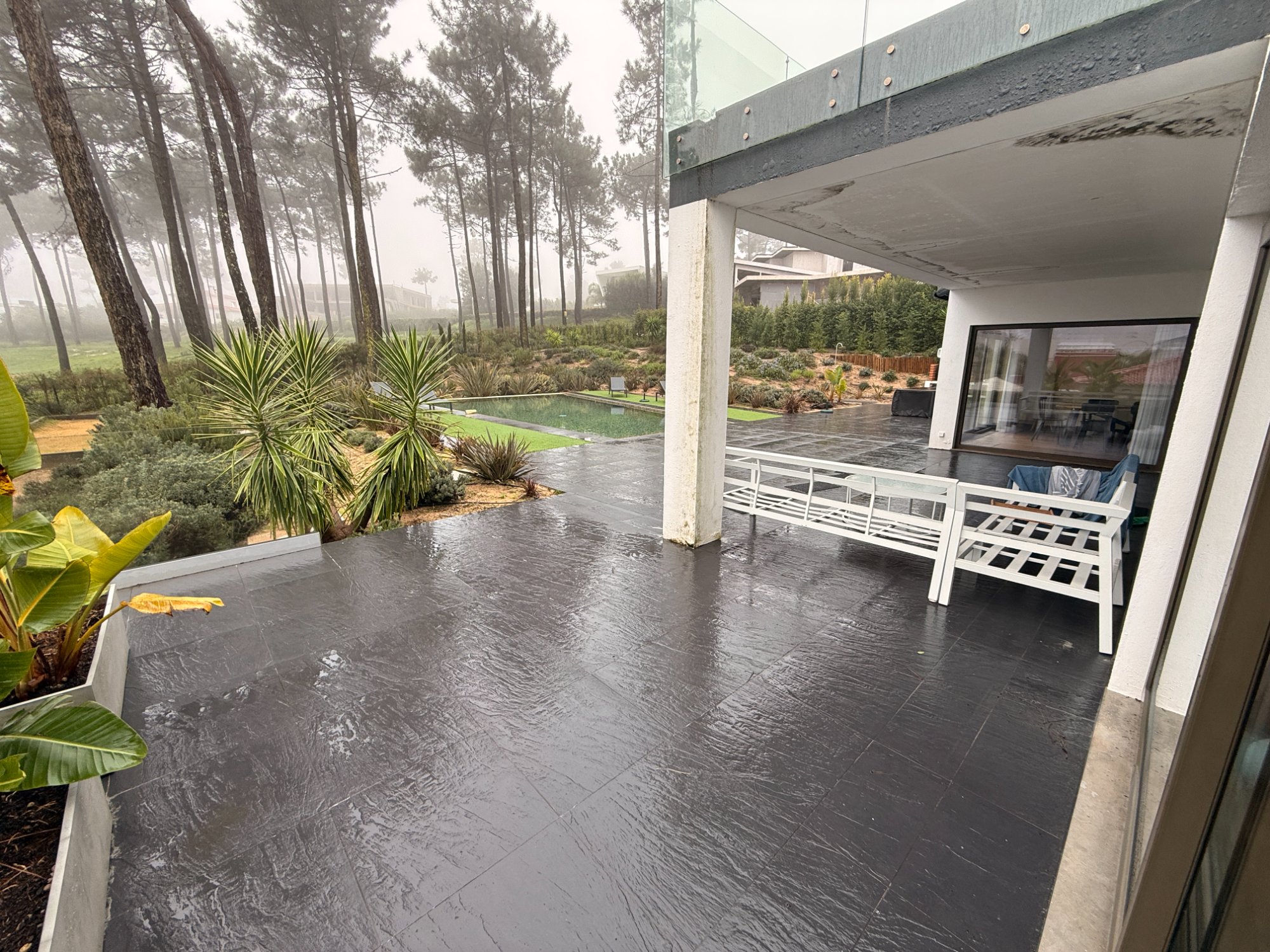
4. Rear terrace, ground floor
New paving of rear terrace on ground floor
5. Interior work
Painting, mould removal inside, replacement of all suspended ceilings on all ground floor terraces (3)
6. Windows
Replacement of windows in the living and dining areas and raising them to ceiling height

Area overview

# Area Dimensions Area
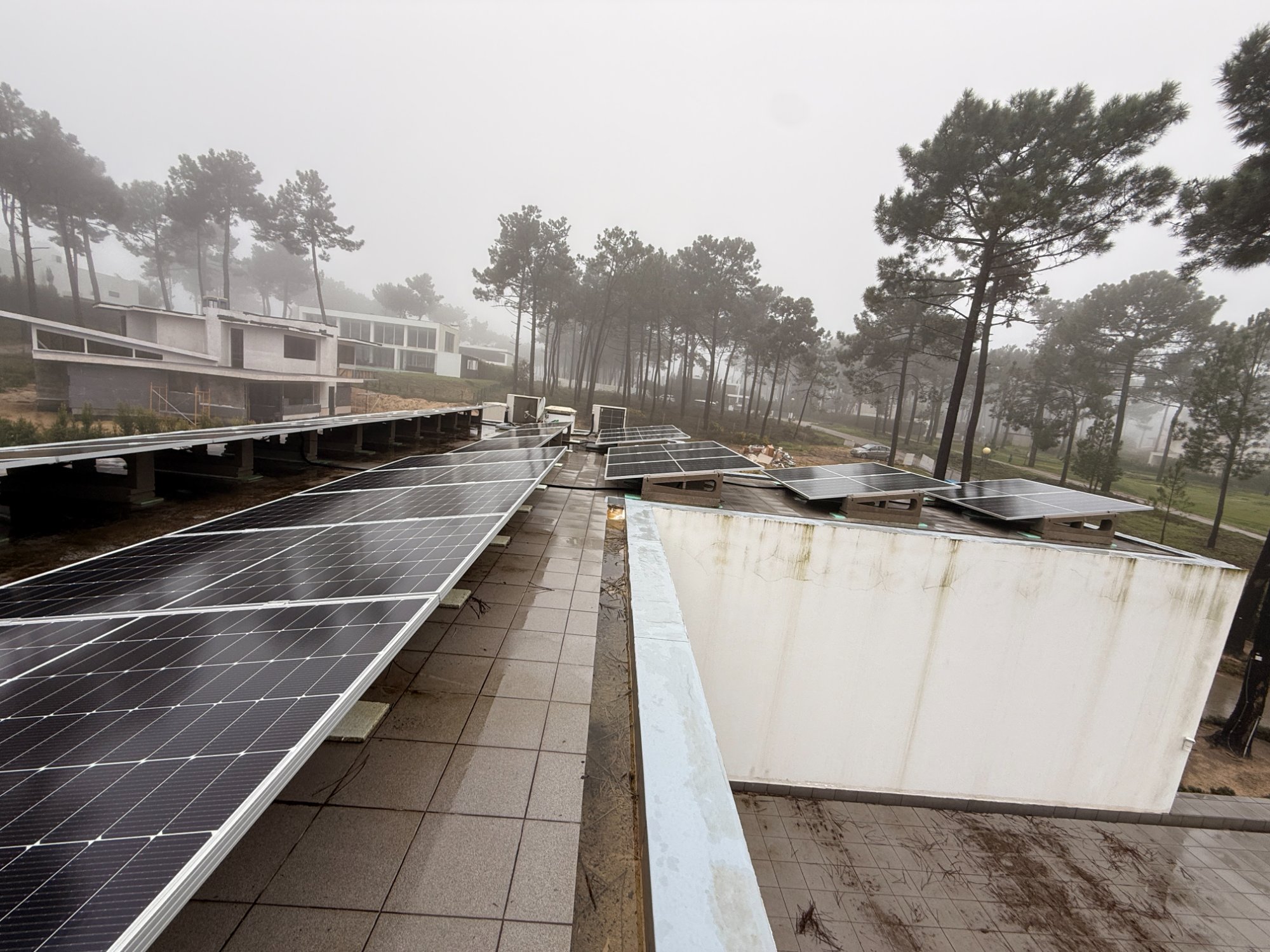
1 Flat roof T-shape 14.25×9.20 + 6.70×7.30 180.0 m
↳ Northern section 14.25 × 9.20 131.1 m
↳ South section 6.70 × 7.30 48.9 m
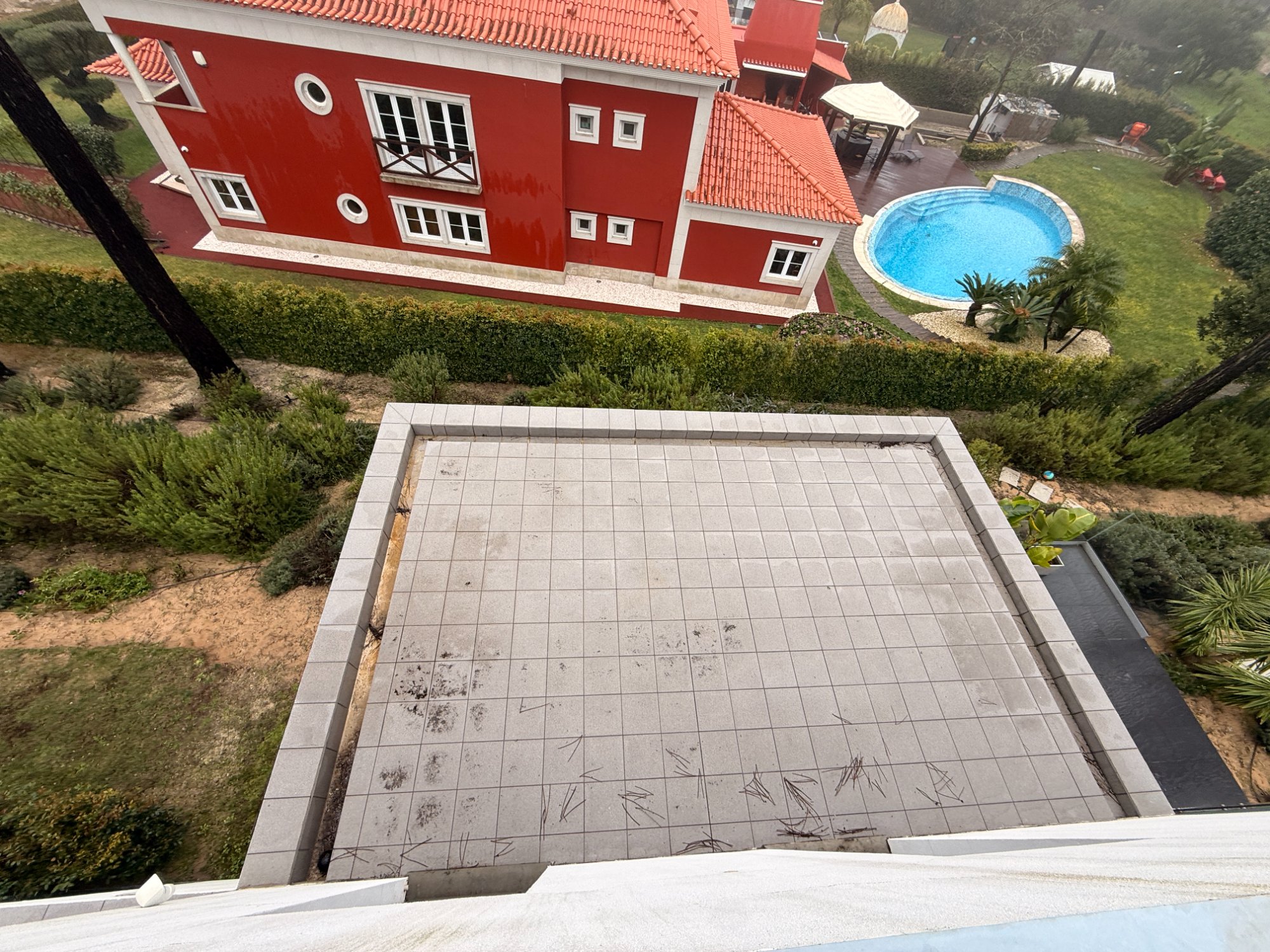
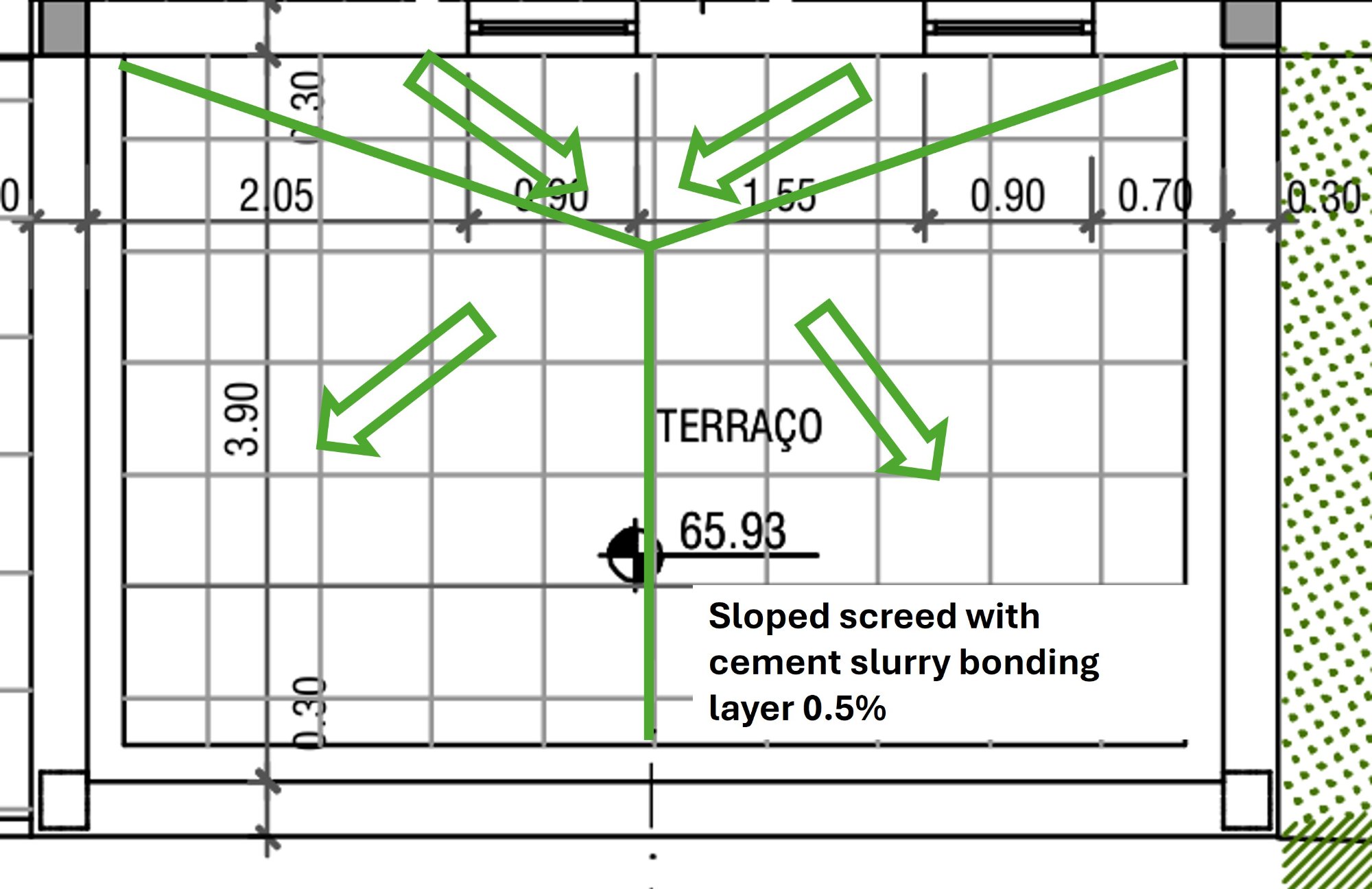
2 Garage roof 5.90 × 5.70 33.6 m
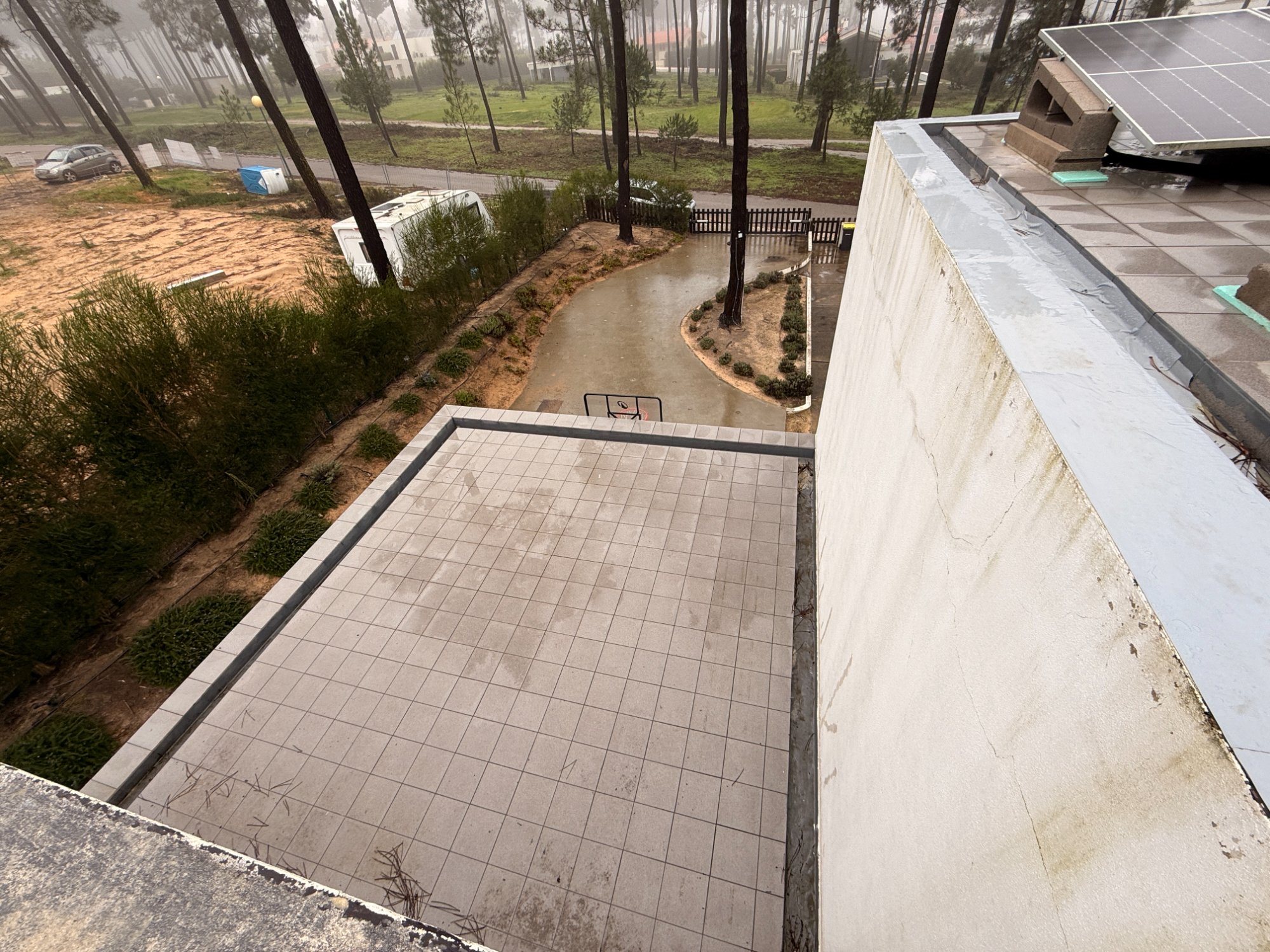
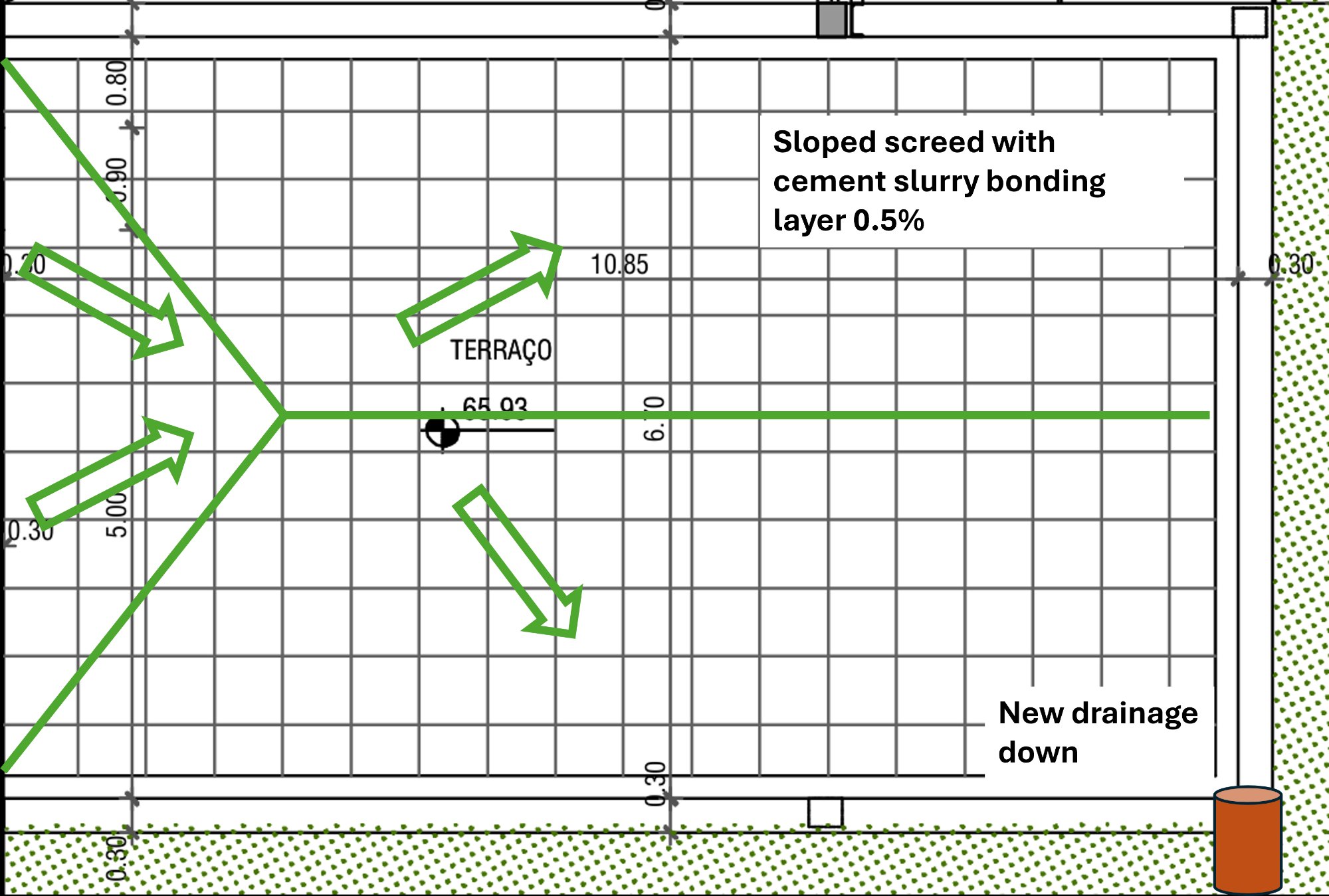
3 Front lawn terrace 11.80 × 7.30 86.1 m
4 Terrace east side 6.70 × 4.50 30.2 m
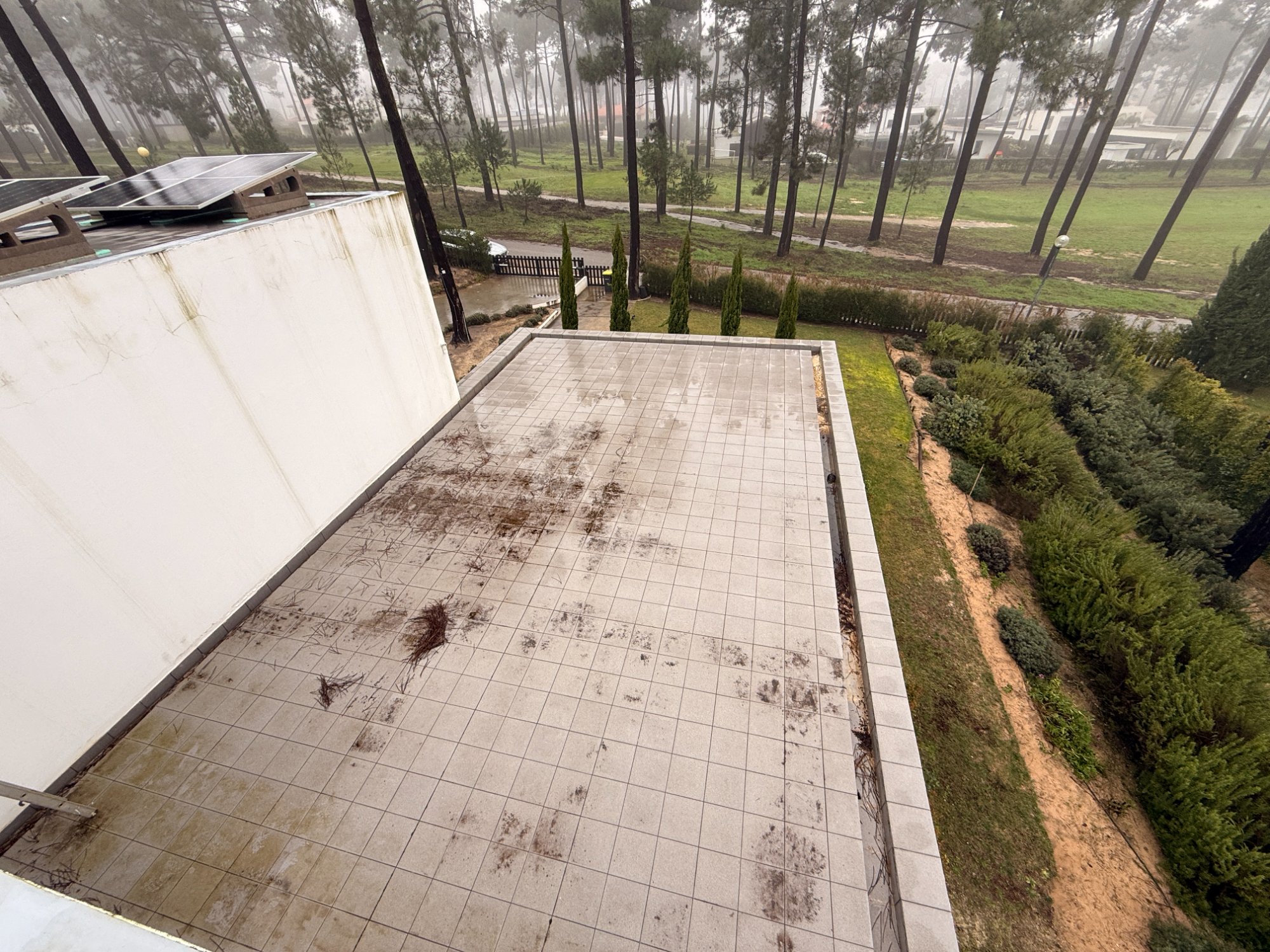
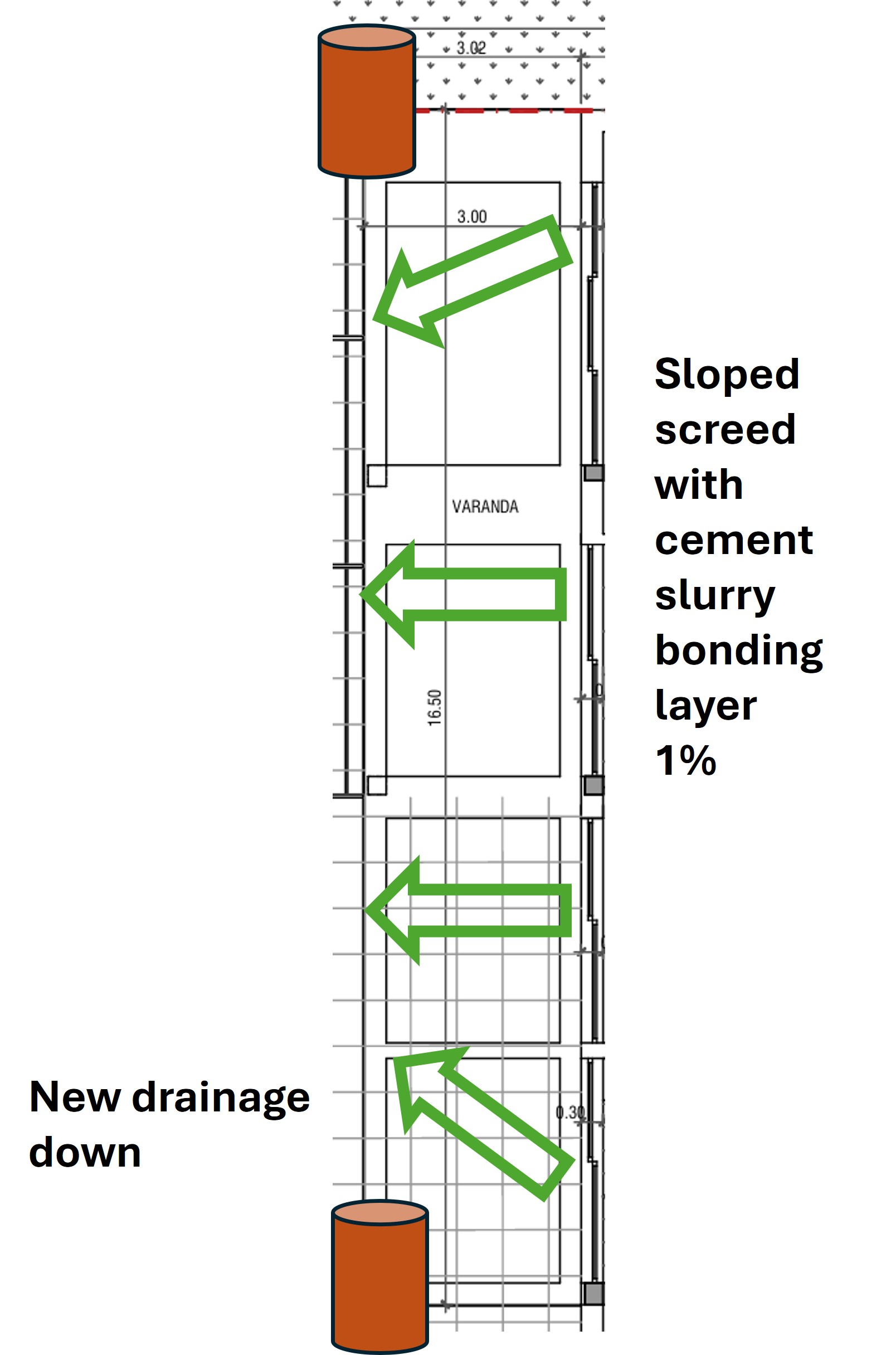
5 Rear balcony 3.00 × 16.50 49.5 m
6 Pool terrace (ground floor) 5 × 21 + 3 × 11.5 − 4.8 × 3.5 122.7 m
↳ Main pool area 5.00 × 21.00 105.0 m
↳ Additional living room & media area 3.00 × 11.50 34.5
↳ Deduction for south garden 4.80 × 3.50 −16.8 m
TOTAL 502.1
Of which with roof insulation 379.4 m
Of which with tiles 322.1 m
📷 Photo glossary
Flachdach
Flat roof
180.0 m²
Balkon Garage
Balcony Garage
33.6 m
Balkon Rasen
Balcony Lawn
86.1 m
Balkon Ostseite
East-facing balcony
30.2 m
Balkon Hinten
Rear balcony
49.5 m
Terrasse Pool
Pool terrace
122.7 m

Property data

Property identification
Land area 2,017 m
Built-up area 307.61 m
Gross area 432.90 m²
Building height 6.36 m
Building permit Alvará 3916/18 (17 July 2018)
Construction process no. 48/17 (C.M. Almada)
Statics & supporting structure
Concrete C30/37
Reinforcing steel A500NR, 500 MPa
Foundations Individual foundations (footings)
Soil bearing capacity 0.20 MPa
Earthquake zone Zone A, soil class II
Wind pressure 0.70 kN/m²
Solar
Number of panels 31
Mounting system SOLARBLOC® V815 (10°)
Number of SOLARBLOC® units approx. 58
SOLARBLOC® Floor space 100 × 21 cm
Total ballast ~3,100 kg

Existing data (from original construction plans)

Load calculation for roof Estimate based on actual ceiling thickness
Load capacity (estimated, 17 cm solid ceiling C30/37)
With 3 m span ~10-12 kN/m²
With a span of 4 m ~7-9 kN/m²
Conservative estimate ~7 kN/m²
Planned roof structure
XPS insulation 80 mm ~0.03 kN/m²
Bitumen waterproofing (2 layers) ~0.15 kN/m²
Payload (access, wind) ~1.00 kN/m²
Total roof structure ~1.2 kN/m²
SOLARBLOC®
SOLARBLOC® V815 + module ~0.50 kN/m²
Total SOLARBLOC® ~1 kN/m²
Total load ~2.2 kN/m²
Reserve ~4.8 kN/m² (>60%)
Actual roof structure (measured in bedroom) Insulation & slope missing!
# Layer Thickness
2 Tiles ~1 cm
1 Bitumen LBM(SBS)-40-FP + adhesive ~0.5 cm
0 Reinforced concrete solid ceiling ~16 cm
(rod camera confirmed: no hollow bodies/ribs)
Total package (measured) 17.35 cm
⚠️ No slope, no insulation – plans were not implemented!
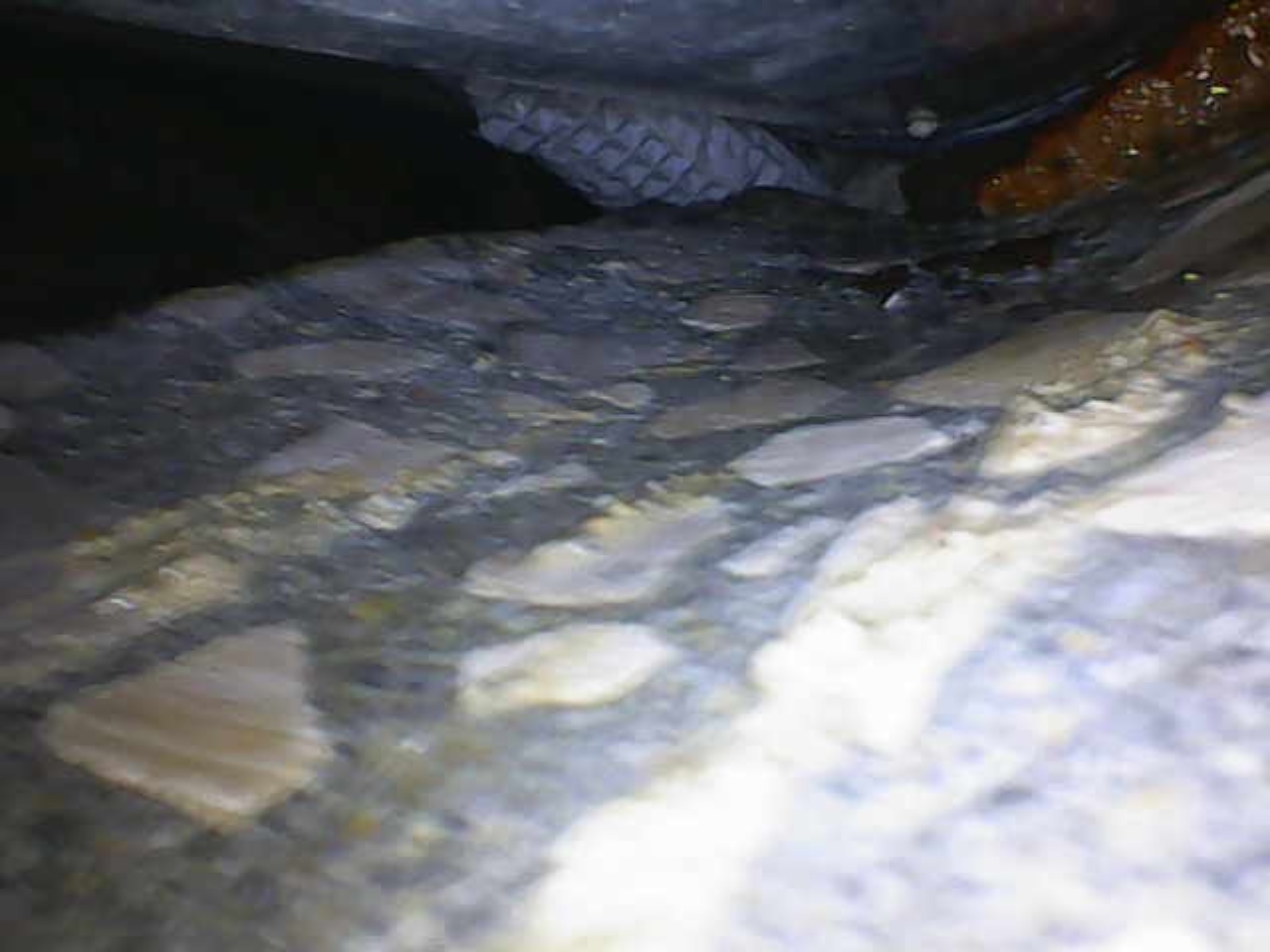
📷 Ceiling findings roof (rod camera via ventilation opening)
Dachdecke Massiv
Roof ceiling from below
Solid ceiling – no ribs visible
Deckenstruktur
Concrete structure
Homogeneous concrete with aggregates
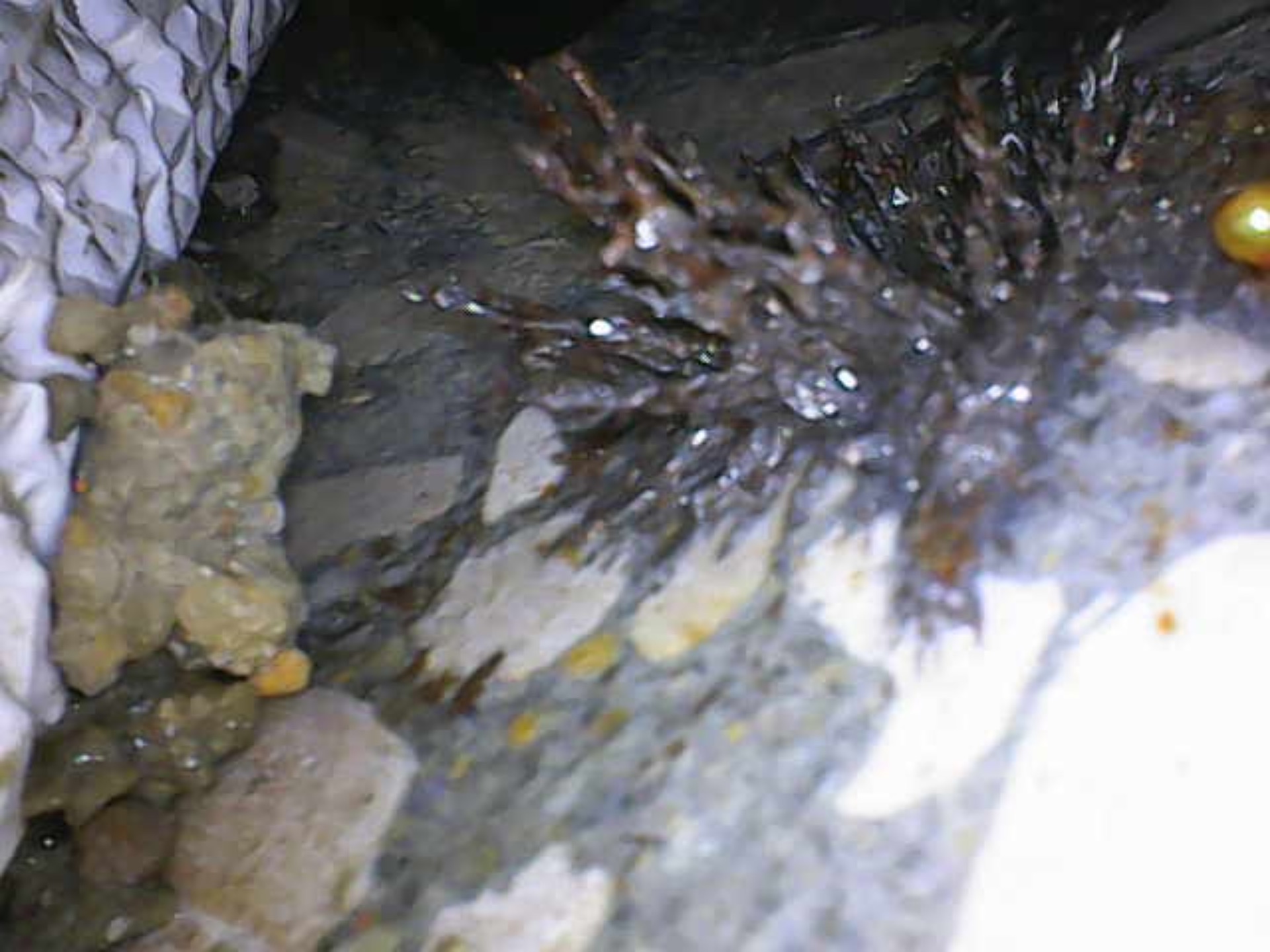
Kalkausblühung
Lime efflorescence
Star-shaped – water ingress
Interpretation of roof ceiling:
Ceiling type: Solid ceiling ~17 cm (no hollow bodies/ribs visible) – deviates from plans!
Lime efflorescence: Water ingress due to leaky roof sealing, calcium dissolves from concrete and crystallises
Long-term risk: reinforcement corrosion if moisture continues to enter
Measure: Urgent replacement of roof sealing
Load calculation for false ceiling on 1st floor / balconies according to structural planning (PLANO 300)
Design loads (planning)
Ceiling type Hollow core ceiling 16+4 cm (plan-compliant)
Total load (planning) 4.86 – 9.39 kN/m²
of which permanent load 3.86 – 6.39 kN/m²
of which live load 1.00 – 3.00 kN/m²
Max. span (garage) 5.50 m
Planned construction (Margres EVOKE Light Grey, tbd)
Margres EVOKE Light Grey (tbd) 60×60×1cm ~0.23 kN/m²
Adhesive/screed ~0.30 kN/m²
Bitumen waterproofing (2 layers) ~0.15 kN/m²
Total structure ~0.7 kN/m²
+ Payload (access, wind) ~1.0 kN/m²
Total planned load ~1.7 kN/m²
Reserve vs. design (min. 4.86 kN/m²) >3 kN/m² ✓
📷 Ceiling findings 1st floor / balcony
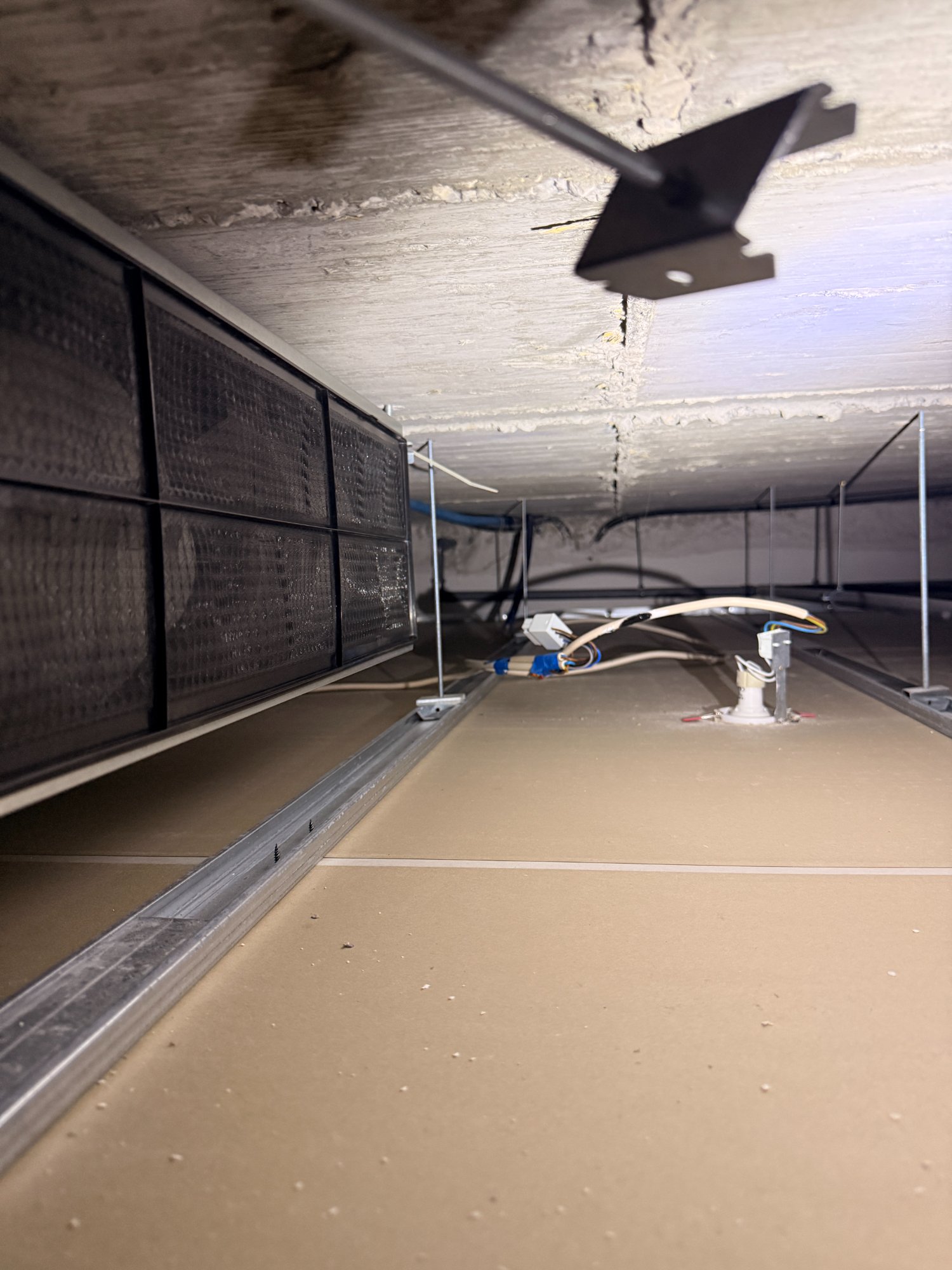
Abhangdecken-Hohlraum
Hollow space in suspended ceiling, 1st floor
Hollow core ceiling with visible ribs – as planned
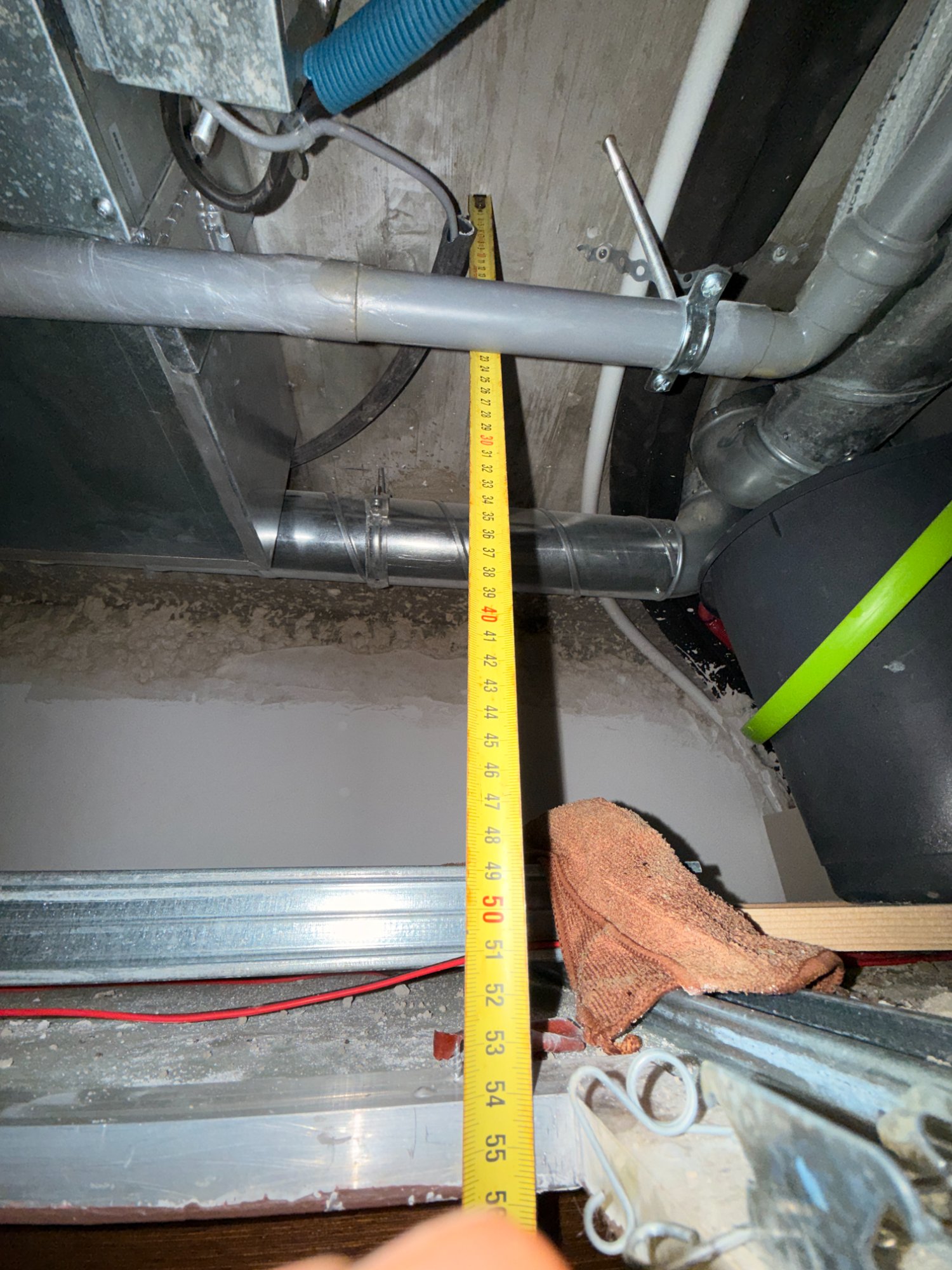
Total package (measured in dining room) 28 cm
Interpretation 1st floor / balcony:
Ceiling type: Hollow ceiling (ribs visible) – corresponds to plans (16+4 = 20 cm)
Structure: ~8 cm (screed, tiles, etc.)
Rainwater drainage (existing according to planning)
Design area 490 m
Design rainfall 5-minute event, 10-year recurrence
Downpipes DN 110
Gutter slope (planning) 2–3
(not implemented as planned) often no gradient
Collecting pipe DN 160
Max. depth of rain gutters (measured) 15–20 cm
ETICS façade (existing according to planning) Attic connection relevant
System ISOVER Clima 34 + Weber.therm
Insulation Mineral wool 60 mm, λ = 0.034 W/(m·K)
Reinforcement Weber.therm Base (polymer mortar)
Plaster Weber.pral Clima (scratch plaster)
Masonry Hollow brick 22 cm
U-value 0.45 – 0.46 W/(m²·K)
Total thickness of façade (planning) ~30 cm
Total thickness of façade (measured) 38 cm
📷 Wall findings (rod camera via ventilation opening)
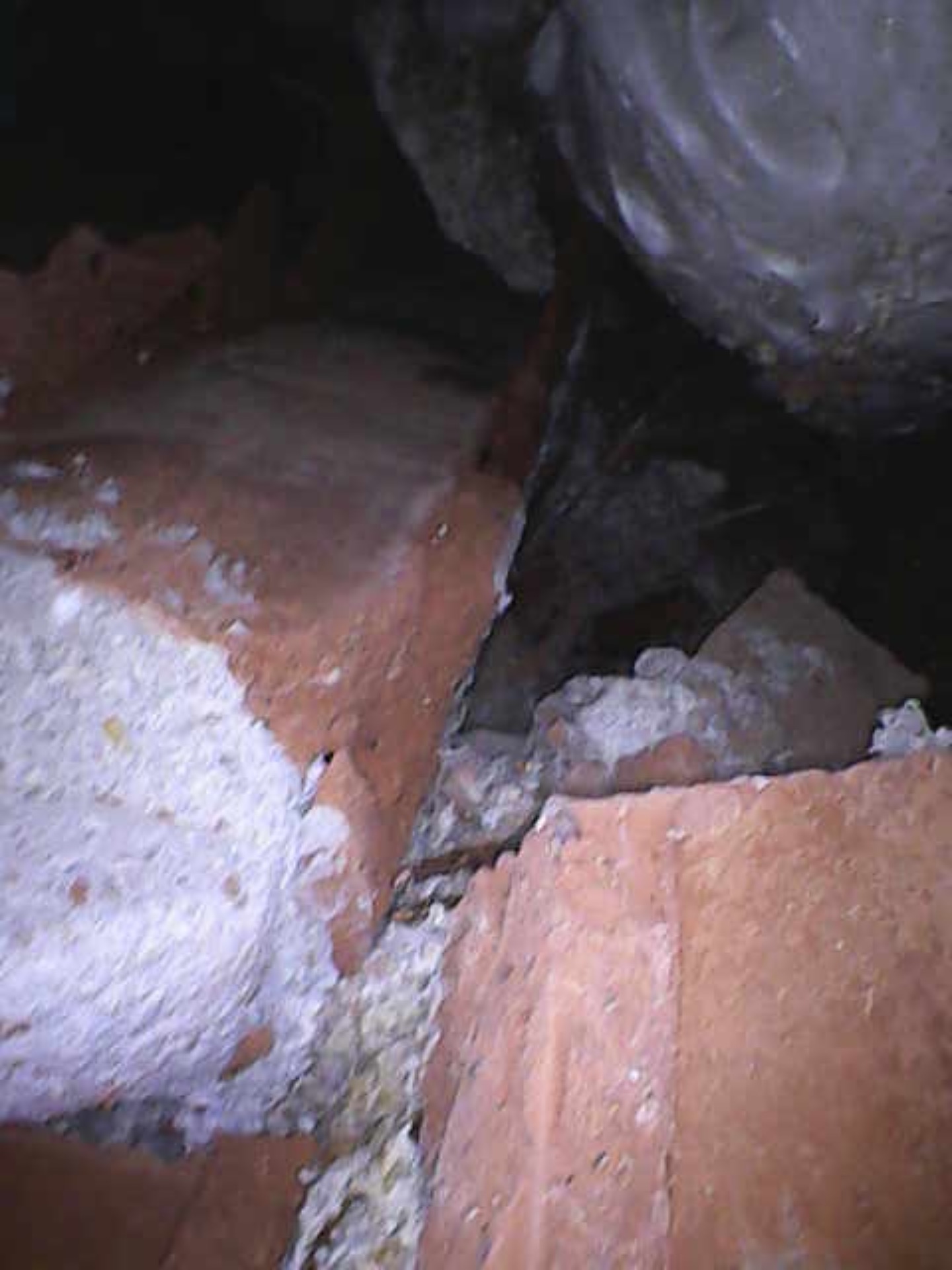
Hohlziegel
Hollow bricks
Tijolo furado – corresponds to plans
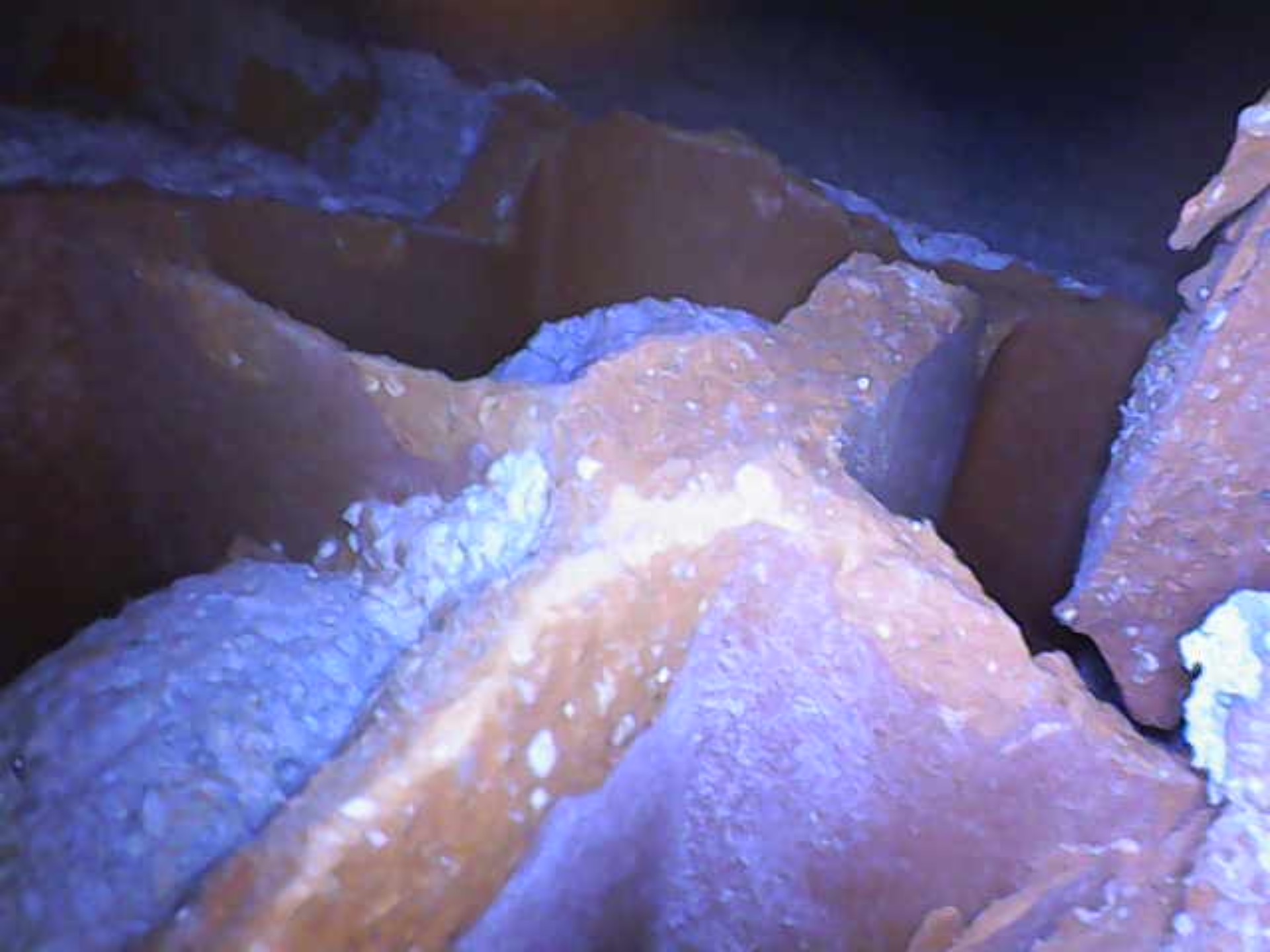
Hohlziegel innen
Hollow bricks inside
Efflorescence in joints – water path visible
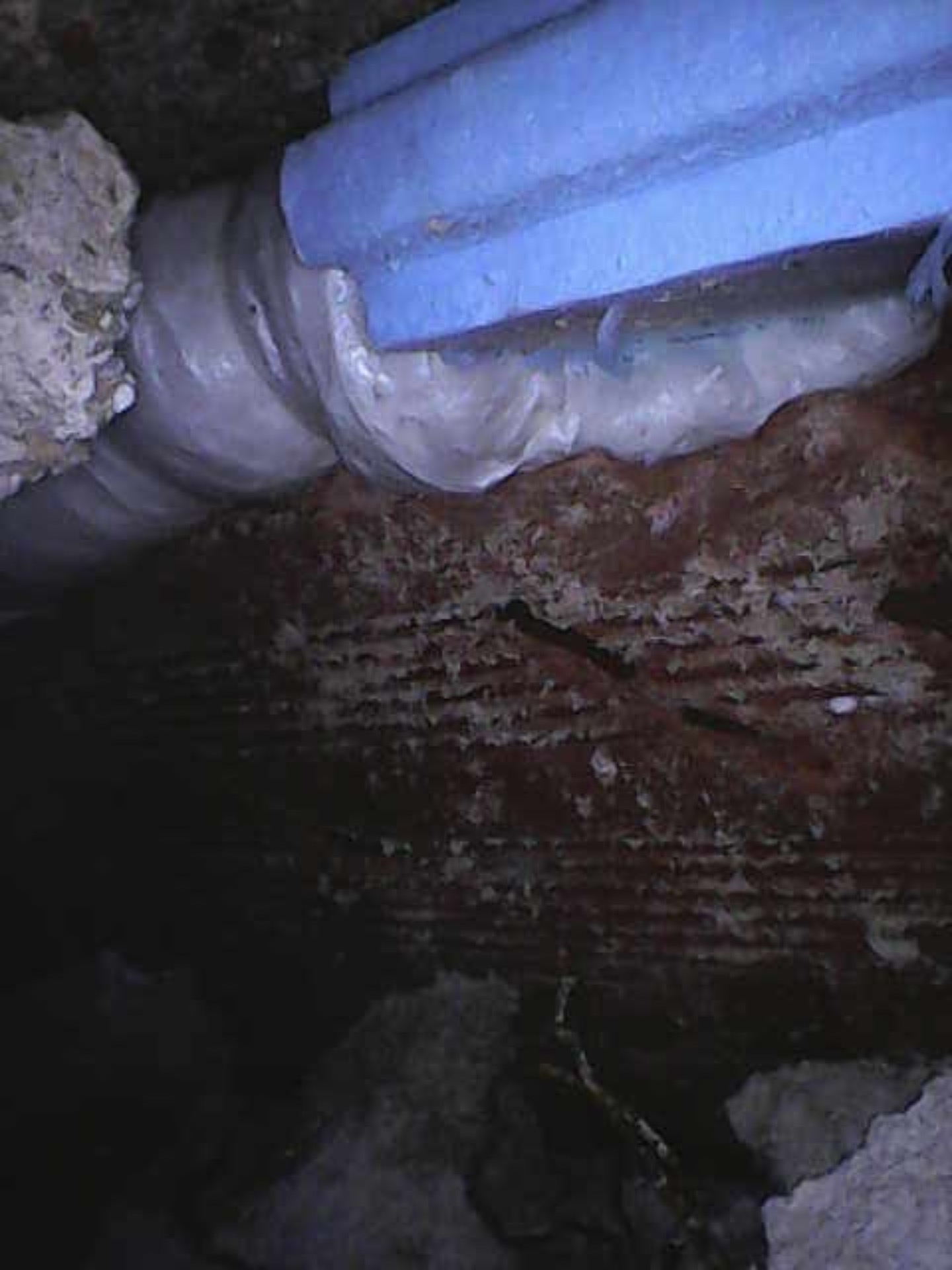
Rohrdurchführung
Pipe penetration
XPS insulation, grooved hollow bricks
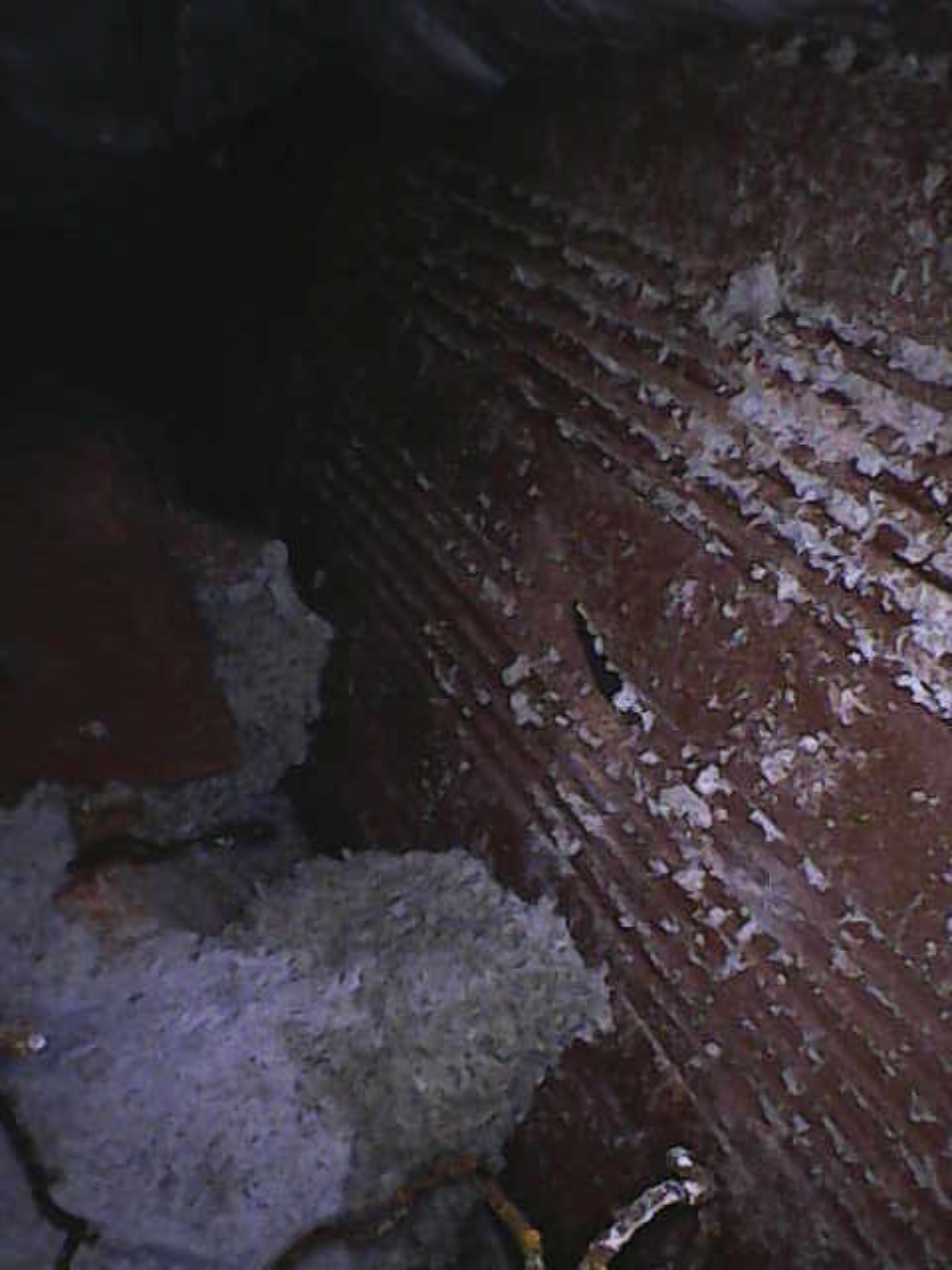
Ausblühungen Wand
Efflorescence
Salts due to water ingress
Interpretation of wall findings:
Masonry: Hollow bricks (Tijolo furado) – corresponds to plans (22 cm)
Efflorescence in joints: Water seeps through mortar joints, dissolving salts and calcium
Water path: From leaky roof sealing through masonry downwards
Condition: Substance intact, but long-term frost damage and plaster detachment possible
Solar (current situation)
Number of panels 31
Mounting system SOLARBLOC® (10°)
Number of SOLARBLOC® approx. 58
SOLARBLOC® dimensions
Floor space 100 × 21 cm
SOLARBLOC Montagesystem
Original planning for roof structure (not implemented) Acoustics project 2017
# Layer Thickness
7 Margres tiles 20×20 cm 1 cm
6 Cement mortar 4
5 Polyester geotextile 0.1 cm
4 Bitumen LBM(SBS)-40-FP (single layer) 0.4 cm
3 Mineral wool (weldable) 5 cm
2 Levelling mortar 4 cm
1 Expanded clay (slope formation) 5
0 Hollow core slab 16+4 20
Planned above raw ceiling ~19.5 cm
U-value (planned) 0.49 W/(m²·K)

Facade (ETICS on side walls + front wall lawn · front and rear only painted)

Overview 3 zones
Zone Action
Side walls + front wall Lawn Plaster renovation → ETICS (EPS) → Top coat + paint
Rear and front Plaster renovation → paint only (no ETICS)
Glass façade Balconies Recess – no ETICS, aluminium end profiles at edges
Layer structure ETICS – FASSATHERM® Classic (side walls + front wall lawn) 9 steps · Fassa Bortolo
9 Final plaster – DEKOR VELLUTO Silicone resin plaster (Velluto effect)
8 Primer – INERT 401 Adhesive bridge for the final coat
7 APU strips (windows) For a tight connection to window frames, with integrated fabric
6 Profiles – Corner protection angle + base PVC corner protection angle with integrated fabric on all building corners · Base end profile at the bottom · Aluminium end profiles on glass façade recesses
5 Fabric – FASSANET 160 Glass fibre fabric (160 g/m²), overlap min. 10 cm, embed in the outer third of the reinforcement layer
4 Reinforcement mortar – FK 626 Fibre-reinforced reinforcement mortar, embed FASSANET 160 in the outer third
3 Dowel – COMBI FIX PLUS Disc dowels 135–155 mm long (for 80 mm insulation + adhesive + old plaster), only after the adhesive has hardened (min. 24 hours)
2 Insulation – GRAPHITHERM 031 (80 mm) EPS graphite (λ 0.031 W/mK) · Panels in a bond pattern (never cross joints) · Recesses for glass facades on balconies
1 Adhesive mortar – AL 88 Bead-dot method, min. 40% adhesive surface
0 Inventory & plaster renovation Check existing insulation (ETICS intact → only knock off plaster, otherwise completely new). Remove hollow areas, cut open cracks >0.3 mm and fill with filler
Rear and front (only painted, no ETICS) 3 steps
3 Facade paint 2× coat UV-resistant, water-repellent
2 Primer Deep primer on renovated plaster
1 Plaster renovation Tap hollow areas, remove loose areas, fill cracks

📋 Work instructions

ETICS inventory check:

Check existing wall insulation before starting – do not apply double ETICS!
ETICS present and intact: Only remove plaster/paint, leave existing insulation in place, new reinforcement + top coat
ETICS defective or not present: Completely rebuild (steps 0–9)

Plaster adhesion test:

Systematically tap the entire façade. Mark and remove any areas that sound hollow. Cut open cracks >0.3 mm and fill with repair mortar. Plaster must adhere to the entire surface before EPS is bonded.

EPS panel installation:

• Lay the boards in a pattern (staggered like brickwork), never cross joints
• Bonding area min. 40% of the panel back (edge bead + blobs)
• Only insert COMBI FIX PLUS plate dowels after the adhesive has hardened (min. 24 hours)
• At building corners: corner boards in a staggered pattern

Window and door openings:

• APU strips for a tight connection to all window frames
• Diagonal reinforcement at all window corners (20×40 cm pieces of fabric at a 45° angle under the main fabric)
• Never allow ETICS to meet at window corners – always cut out in an L-shape

Glass façade recess:

ETICS is recessed on balconies with glass facades. Finish the edge neatly with an aluminium end profile, connecting joint with permanently elastic sealant (Sikaflex-11 FC+).

⚠️ Killer questions:

1. Bead point method (AL 88) meticulously executed? The adhesive edge must be closed all around – this prevents underflow and panel movement.
2. Are the dowels long enough? For 80 mm EPS + adhesive + old plaster: min. 135–155 mm length.
3. APU strips installed on all windows? Direct plaster connection to the frame immediately leads to cracks in Portugal due to UV expansion.
4. Diagonal reinforcement installed at window corners? Additional 20×40 cm fabric at a 45° angle under the main reinforcement is mandatory.
5. Fabric (FASSANET 160) in the outer third? Must not lie directly on EPS, must be embedded in FK 626.
6. EPS graphite protected from the sun? Grey panels warp/bend extremely quickly when exposed to direct heat unless reinforced.
7. Is the adhesive layer on the wall head correct? The waterproofing of the wall head must overlap the facade insulation at the top – strictly from top to bottom down to the gutter.

⚠️ Observe drying times:

• After bitumen sealing of balconies: wait at least 3 months before applying ETICS to balcony walls
• Measure wall moisture: equilibrium moisture below 3–5%
• Do not apply in rain, frost or direct sunlight

Roof structure (flat roof)

Layer structure from bottom to top 12 layers
12 SOLARBLOC® + modules 58 blocks, 10°
11 Rubber mat 6 mm + bitumen sacrificial layer Mat 120×40 cm, bitumen membrane with chippings 130×50 cm (loose)
10 Sikalastic-560 WHITE (top layer) Cool Roof, 82% reflection
9 Sikalastic-560 Base + Fleece-120 Fleece embedded wet-on-wet
8 Bitumen top layer ESTERDAN 40 P ELITE Self-Adhesive (mineral/GP, UV & colour)
7 Aluminium drip edge (parapet) Rivnet ITE 60/160 – degreased, bonded with Sikaflex-11 FC+, screwed, screw heads sealed with Sikaflex
6 Bitumen underlay ESTERDAN 30 P ELITE – up to above wall tops, 5 cm down the wall
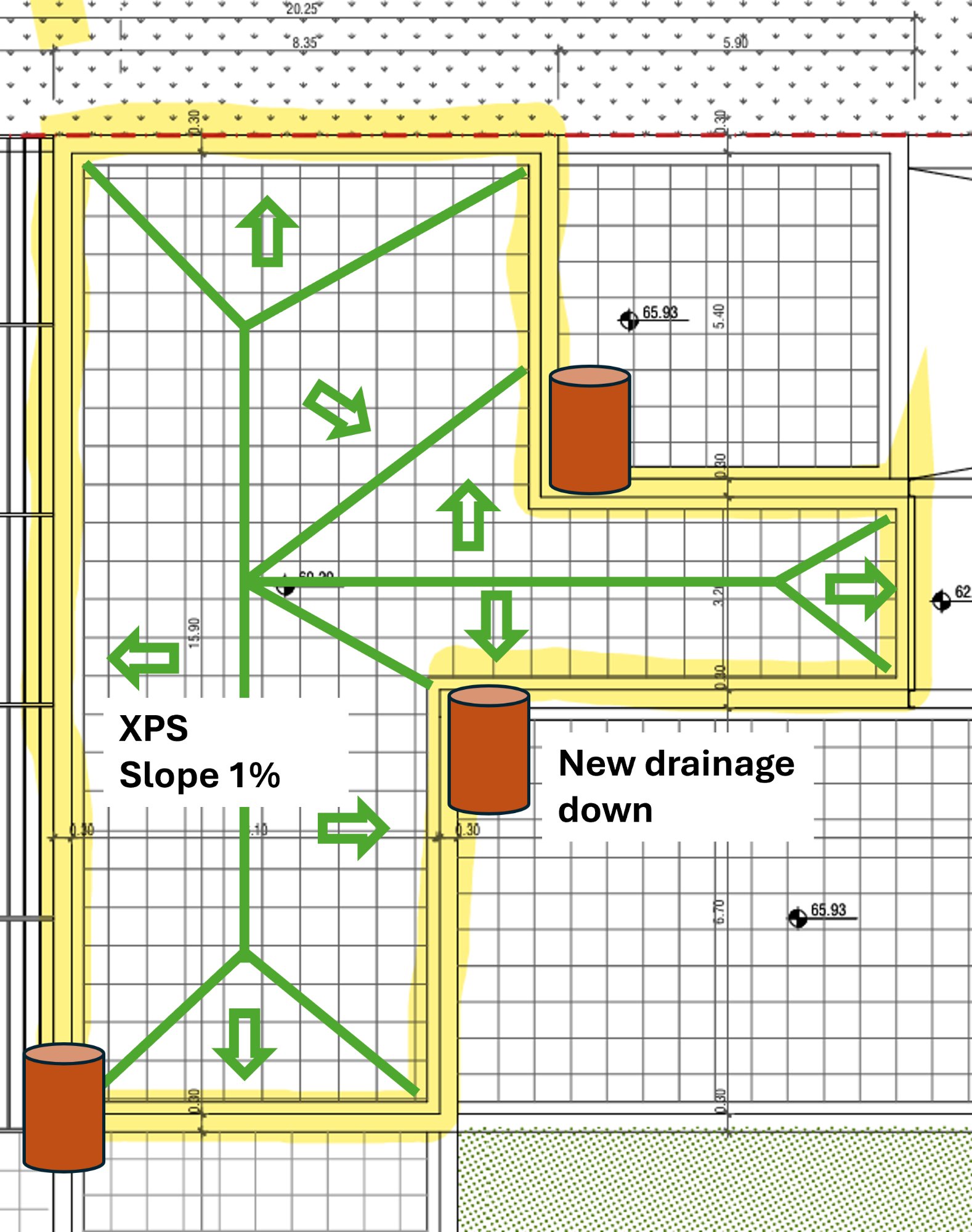
5 Danopren 500 kPa Gradient insulation 6→10.2 cm, 1% slope, with diagonal cuts (T-shape)
4 Vapour barrier Self-Dan Alu – on roof surface up to drainage channel
3 Bitumen primer BITUMEN PRIMER+ SA on roof, gutters and wall heads
2 Gutter preparation U-shaped curve, eliminate sharp edges, maximum possible slope ≥1%
1 Lay down downpipes 3 new ones: (1) east side, southeast corner, (2) corner of lawn terrace, (3) corner of garage terrace
0 Surface strip-back & preparation Completely remove tiles and primer, create a level surface. Wall tops: 2% slope inwards (towards the roof). Cleaning and repairing concrete
📐 Slope & drainage plan for roof XPS Slope 1% · 3 new downpipes
Gefälleplan Dach – XPS Slope 1%, neue Drainage

📋 Work instructions

Bitumen at diagonal joints on the roof slope:

Apply a 30 cm wide strip of ESTERDAN 30 P ELITE SELF-ADHESIVE over the diagonal joints of this layer.

🎨 Sikalastic-560 + Fleece-120 Application:

1. Apply Sikalastic-560 base (~0.75–1.0 kg/m², only as far as the material remains liquid)
2. Immediately insert Fleece-120 (into the wet layer, no bubbles/creases)
3. Press down with a roller – overlap min. 5 cm, overlaps must remain wet
4. Apply Sikalastic-560 top coat over the fleece (~0.25–0.5 kg/m², wet-on-wet)
5. After drying: seal with 1–2 further layers of Sikalastic-560 (≥0.5 kg/m² per layer)

Balconies (1st floor: 4 balcony areas)

Layer structure from bottom to top 11 layers
11 Joints & expansion joints ARJUNT UNIVERSAL min. 4–5 mm · Expansion joints every 3–4 m with Sikaflex-11 FC+, 10 mm wide, continuous to dimpled membrane
10 Sikalastic-560 GREY (top layer) – gutters only Sealing of gutters
9 Sikalastic-560 Base + Fleece-120 – gutters only Fleece embedded wet-on-wet, only in drainage gutters
8 Tiles 10 mm – Margres EVOKE Light Grey (tbd) – with flexible adhesive S2 Margres Evoke Light Grey 60×60 / 60×30 · weber.col flex XL (S2), buttering-floating · Balcony areas and wall tops up to the aluminium drip edge
7 Slope level – Sika MonoTop-4100 Protect Repair mortar, low shrinkage – creates 0.5% gable roof slope (see drawing), rear balcony 1% slope
6 Drainage – DANODREN H15 PLUS Dimpled membrane with fleece on top – decoupling + drainage, fleece overlapping seamlessly
5 Bitumen top layer ESTERDAN 40 P ELITE Self-Adhesive – lay from top to bottom (roof tile principle). Over coving 20 cm up the wall (behind ETICS), fasten at the top with aluminium clamping rail and finish with Sikaflex. Connect to windows with Sikaflex. Corners: extend 15–20 cm around the corner, corner strips as reinforcement
4 Aluminium drip edge (parapet) Rivnet ITE 60/160 – Cover ETICS, degrease, bond with Sikaflex-11 FC+, screw in place, seal screw heads with Sikaflex. Rear balcony: Drip edge on all 3 open sides
3 Bitumen underlay ESTERDAN 30 P ELITE – lay from top to bottom (roof tile principle). Over coving 20 cm up the wall (behind ETICS), over wall heads down to 5 cm on the outside (under ETICS). Corners: lead 15–20 cm around the corner
2 Adhesive primer BITUMEN PRIMER+ SA – dust binding + bonding bridge, allow to dry completely
1 Lay down downpipes 1 new downpipe on balcony front lawn at north-east corner of building. Drainage on left and right at rear of balcony, terrace side under terrace into new septic tank to be created in garden
0 Surface strip-back & preparation Completely remove tiles and primer, create a level surface. Wall tops/outside in front of gutter: 2% slope inwards. Cleaning and repair of all concrete surfaces
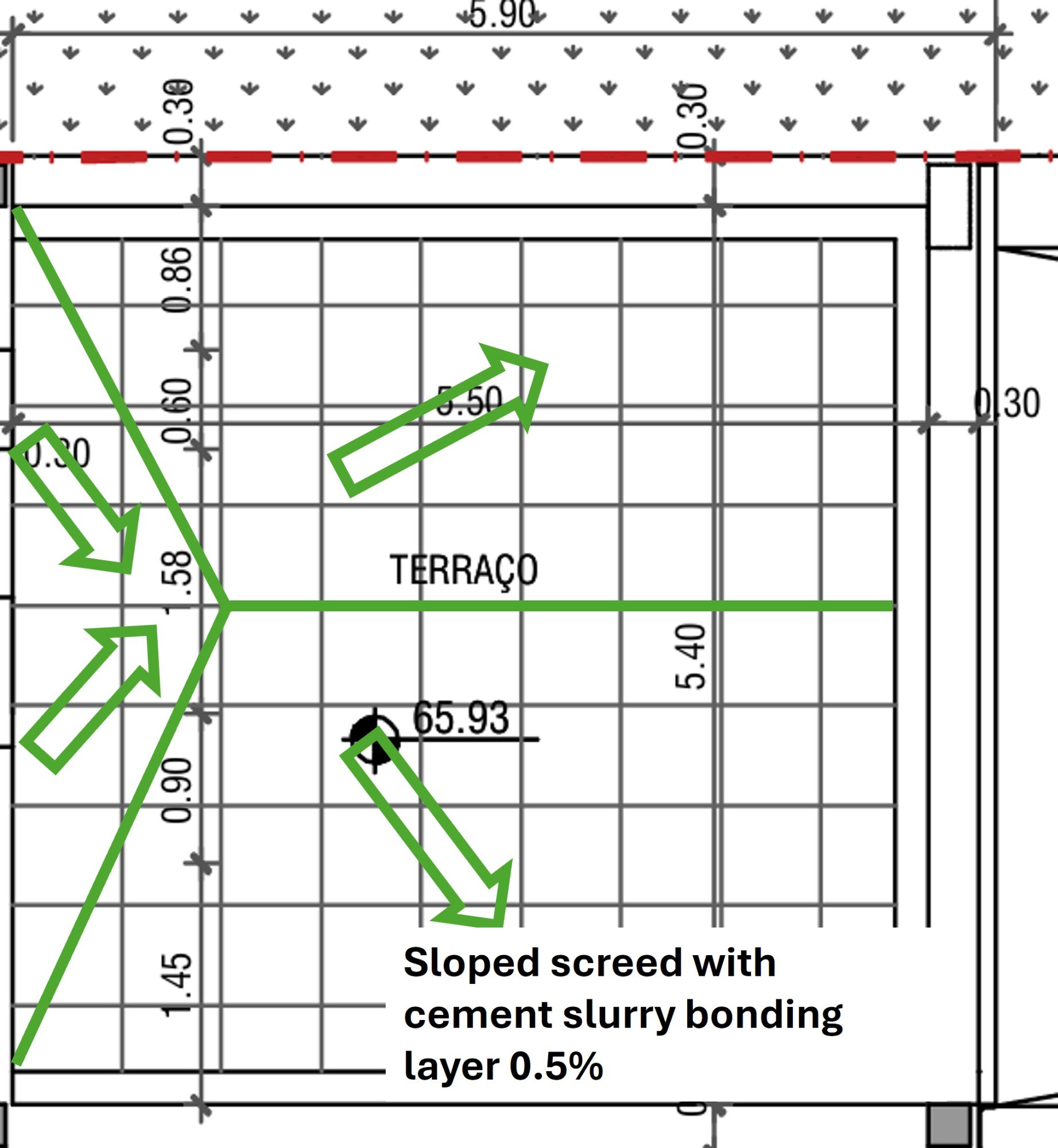
📐 Slope & drainage plans for balconies 4 balcony areas
Gefälleplan Balkon Garagendach
2 · Garage roof
Gable roof 0.5% · Screed with cement slurry
Gefälleplan Balkon Vorderrasen
3 · Front lawn
Gable roof 0.5% · New downpipe in the north-east corner
Gefälleplan Balkon Ostseite
4 · East side
Gable roof 0.5% · Screed with cement slurry
Gefälleplan Balkon hinten
5 · Rear balcony
Monopitch roof 1% · Screed with cement slurry

📋 Work instructions

Joint strategy for lengths of 10+ metres:

1. Normal joints: ARJUNT UNIVERSAL with a minimum width of 4–5 mm. Narrow joints crack immediately in heat.
2. Expansion joints (field boundaries): One approx. 10 mm wide joint every 3–4 m. Do not fill with joint mortar, but completely with Sikaflex-11 FC+. This joint must be congruent through tiles and mortar bed to the dimpled membrane.

Expansion joints must be congruent:

The elastic joint (Sikaflex) must run through the entire structure – exactly where the Rivnet rails have their 5 mm spacing. Joint in tile, mortar bed and drainage mortar exactly on top of each other.

Bitumen installation:

• Lay all bitumen layers strictly from top (ridge) to bottom (gutter).
Corners: Extend strips 15–20 cm around the corner to the adjacent side, overlapping the second strip on top. Place a separate corner strip (30 cm wide) under the surface strips for reinforcement
• Over diagonal butt joints: stick a 30 cm wide strip of ESTERDAN 30 P ELITE SELF-ADHESIVE
• Allow the primer on the cement screed to dry completely – solvent residues prevent permanent adhesion of the ESTERDAN strips

DANODREN H15 PLUS – fleece overlap:

Overlap the fleece without gaps. As soon as cement residue from the ARGACAD runs into the studs, a rigid connection is created and the decoupling is lost.

Wall connections (windows):

Use Sikaflex-11 FC+ as an elastic seal to the wall/frame – never use hard joint mortar. Allow sufficient clearance for thermal movement.

Slope planning for balconies & terraces

Boundary conditions for front balconies Max. 50 mm installation height
Available height (top of tile → top of window) 30
Gain through surface strip-back (tile + adhesive + bitumen) +~20 mm
Available from raw ceiling ~50 mm
Fixed structure (all balconies identical)
Tile 10 mm – Margres EVOKE Light Grey (tbd) + adhesive min. 5 mm 15
DANODREN H15+ dimpled membrane 8
Bitumen Esterdan 40 + 30 7
Total fixed 30
Summary of installation heights
Balcony Type Flow path Fixed Slope Emergency slope
1 tile → wall 0.5%
Total
2 · Garage roof Gable roof 2.85 m 30 mm 14 mm 3 mm 47 mm
3 · Front lawn Gabled roof 3.65 m 30 mm 18 mm 3 mm 51 mm
4 · East side Gable roof 3.35 m 30 mm 17 mm 3 mm 50 mm
5 · Rear balcony Pent roof 3.00 m 30 mm 15 mm 3 mm 48 mm

Rear terrace, ground floor (pool terrace)

Area overview 122.7 m² · New substrate
Sub-areas
Main area Pool 5.00 × 21.00 m 105.0 m
Additional area Living room & media room 3.00 × 11.50 m 34.5 m
Deduction for south garden 4.80 × 3.50 m −16.8 m
Net tiled/screed area 122.7 m
Boundary conditions Ground floor on concrete · New structure
Substrate Concrete slab on ground floor (existing flooring will be completely removed)
Height restriction Less critical than balconies – no window sill limit as on upper floors. Check installation height on site after surface strip-back.
Slope Over sloped screed (not flexible adhesive as with balconies)
Drainage Slope towards pool/garden (away from the house)
Layer structure from bottom to top 8 layers
8 Joints & expansion joints ARJUNT UNIVERSAL + Sikaflex-11 FC+ (expansion joints)
7 Tiles 20 mm – Margres EVOKE Light Grey (tbd) – Anthracite 60×60 Outdoor tile frost-resistant, R11 slip-resistant
6 Flexible adhesive S2 – weber.col flex XL 5–8 mm · highly flexible S2
5 Sloped screed 30–60 mm variable · Cement screed with 0.5% slope towards pool/garden
4 Bitumen top layer – Esterdan 40 P Elite 4 mm · Self-adhesive
3 Aluminium drip edge (parapet) Similar to terraces above pool room – Rivnet ITE 60/160, degreased, bonded with Sikaflex-11 FC+, screwed
2 Bitumen underlay – Esterdan 30 P Elite 3 mm · Self-adhesive · 5 cm down the wall
1 Bitumen Primer+ SA Adhesive primer on concrete
0 Surface strip-back & preparation of concrete slab Remove all covering, clean concrete, fill cracks with Sika MonoTop-4100, create a level surface
Expansion joint plan Critical at 21 m length
Main pool area (5 × 21 m)
Longitudinal joints (21 m direction) Every 3–4 m → at least 5 fields of ~4.2 m or 6 fields of ~3.5 m
Edge joints 10 mm all around the house wall, pool surround, walls
Additional area: living room & media room (3 × 11.5 m)
Longitudinal joints (11.5 m direction) Every 3–4 m → 3 fields of ~3.8 m
Joint details
Normal joints ARJUNT UNIVERSAL · min. 4–5 mm width
Expansion joints 10 mm wide · Sikaflex-11 FC+ (elastic, no joint mortar!)
Expansion joints in screed Screed expansion joints exactly under tile expansion joints – continuous from screed to tile surface

📋 Work instructions

Substrate sequence:

1. Complete surface strip-back – tiles, adhesive, old screed down to raw concrete
2. Check concrete – fill cracks with Sika MonoTop-4100, chisel off loose areas
3. Levelling the surface – even out unevenness >5 mm
4. Dry? – Residual moisture <4% (CM measurement) before bitumen

Expansion joints:

1. Seal edge joints all around 10 mm with PE round cord + Sikaflex-11 FC+
2. Never fill expansion joints with joint mortar – only permanently elastic (Sikaflex)

Window

Living room window – enlargement 3 windows · 210 → 240 cm
Measure
Number 3 living room windows
Current height 210 cm
New height 240 cm
Increase +30 cm upwards
Manufacturer Same manufacturer as existing windows
Construction
Lintel/beam Expose existing beams above windows and connect to new window height. If necessary, install new lintels if masonry is cut.
Window connection Connect new windows to beams/lintels – secure with a force-fit connection.

Colour scheme

Roof surface Sikalastic WHITE (Cool Roof)
Gutters + parapets Sikalastic GREY (RAL 7015)
Terraces Anthracite tiles 60×60cm

Workflow

Phase 1: Preparation
Surface strip-back of all surfaces, height measurement, XPS decision
Phase 2: Gutters + parapets Base
2% slope on gutters, Sikalastic+Fleece: gutters completely, parapet top + 10 cm outside
Phase 3: Roof surfaces
Vapour barrier and XPS installation on roof, primer, round off rain gutters and create slope, 1st layer of bitumen
Phase 4: Wall & ETICS
Wall repair, ETICS on side walls + front wall lawn, reinforcement + plaster, 2–4 weeks DRYING
Phase 5: Drip plates + 2nd layer of bitumen
Drip edges on wall tops, 2nd layer of bitumen
Phase 6: Sikalastic top coat
Sikalastic-560 WHITE on roof, balconies & rain gutters in GREY
Phase 7: SOLARBLOC® + tiles
SOLARBLOC® installation, tiles on balconies and terraces
Phase 8: Interior work
Interior refurbishment, roof undersurfaces, terraces, window insulation
Phase 9: Optional
Tiles on parapets

List of materials

Material Quantity
(estimate, to be checked)
Application
Sealing & bitumen
Bitumen Primer+ SA As required Adhesive primer Roof, balconies, ground floor terrace
Self-Dan Alu Pro (vapour barrier) ~200 m² Roof – on roof surface up to gutter
Esterdan 30 P Elite (underlay) ~380 m Roof, balconies, ground floor terrace (1st layer)
Esterdan 40 P Elite (top layer) ~380 m Roof, balconies, ground floor terrace (2nd layer)
Bitumen sacrificial layer ~15 m² ESTERDAN 40 granulated, 130×50 cm (loose), under SOLARBLOC®
Insulation
Danopren 500 kPa Gradient insulation ~180 m² Roof – 6→10.2 cm, 1% slope
XPS 300 kPa flat 3 cm ~200 m Terraces (if height is OK)
Sikalastic system (liquid waterproofing)
Sikalastic-560 white ~180 m² Roof area (cool roof)
Sikalastic-560 grey ~150 m Gutters, parapets, balcony gutters
Sikalastic Fleece-120 ~330 m All Sikalastic surfaces
Sika Primer-3N As required Concrete/plaster adhesive primer for Sikalastic
Profiles & fastening
Aluminium drip edge Rivnet ITE 60/160 ~80 running metres Roof parapet + balconies + ground floor terrace
Sika Primer-204N As required Aluminium profiles Adhesive primer
Sikaflex-11 FC+ As required Profile adhesive, expansion joints, wall connections
Spiral dowels ~80 running metres Profile fastening
Balconies – Construction
DANODREN H15 PLUS ~200 m² Dimpled membrane with fleece – balconies decoupling + drainage
Sika MonoTop-4100 Protect As required Sloping surface Balconies + concrete repair Ground floor
Margres Evoke Light Grey 60×60 / 60×30 (tbd) ~200 m² Balcony tiles 10 mm – Margres EVOKE Light Grey (tbd)
weber.col flex XL (S2) as required Flexible adhesive Balconies + ground floor terrace
ARJUNT UNIVERSAL As required Grout Balconies + ground floor terrace
Ground floor terrace
Anthracite tiles 60×60 (20 mm) ~125 m² Outdoor tiles, frost-resistant, R11 slip-resistant
Cement screed (sloped screed) As required 30–60 mm variable, 1–1.5% gradient
ETICS façade – FASSATHERM® Classic
AL 88 adhesive mortar As required Bead-dot method, min. 40% adhesive surface
GRAPHITHERM 031 (80 mm) As required EPS graphite insulation boards
COMBI FIX PLUS plate dowels As required 135–155 mm, after adhesive has hardened (24 hours)
FK 626 Reinforcement mortar As required Fibre-reinforced, for fabric embedding
FASSANET 160 Glass fibre fabric As required 160 g/m², overlap min. 10 cm
INERT 401 primer As required Adhesive bridge for final coat
DEKOR VELLUTO final coat As required Silicone resin plaster (velvet effect)
APU strips As required Window connection with integrated fabric
PVC corner protection angles + base profiles As required Building corners + base trim
Solar
SOLARBLOC® V815 ~58 pcs. Mounting system 10°
Rubber granulate mat 6 mm ~15 m² Bauder GGM 6, 120×40 cm, under SOLARBLOC®
Miscellaneous
Downpipes DN 110 4 3× roof (south-east, lawn terrace, garage) + 1× north-east balcony
Facade paint As required Rear – UV-resistant, water-repellent, 2 coats
Deep primer As required Back side – on renovated plaster
PE round cord As required Backfilling expansion joints (before Sikaflex)
Aluminium clamping rail as required Balconies – fix bitumen wall connection at the top
Aluminium end profiles As required Glass façade recesses ETICS edges
Aluminium drip tray Ground floor terrace As required Rivnet ITE 60/160, analogous Terraces above pool room
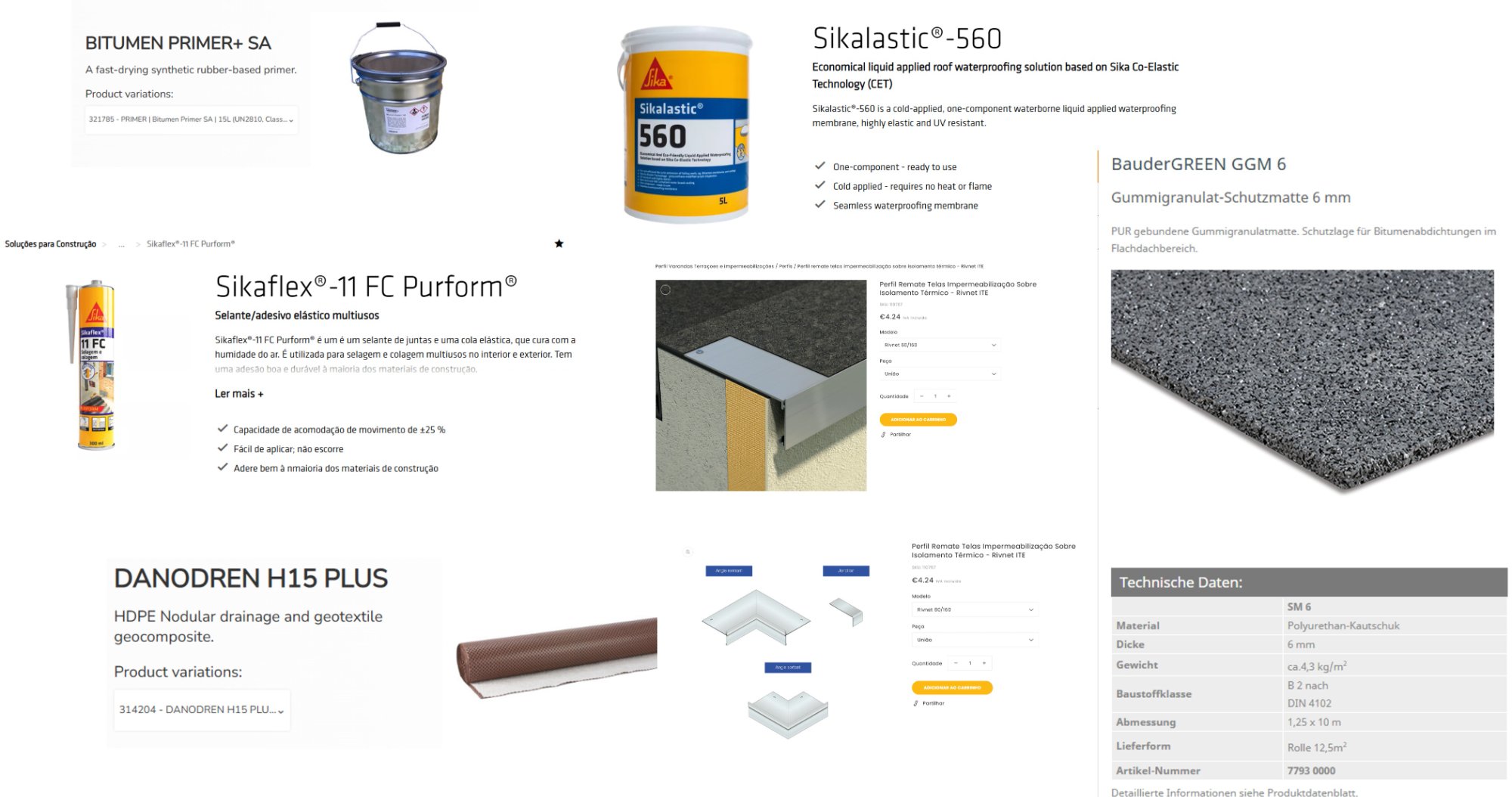
📷 Product overview
Produktübersicht – Abdichtung, Profile, Schutzmatten
Produktübersicht – Mörtel, Kleber, Fliesen, ETICS

Unanswered questions

🔶 Open questions

  1. DANOSA response to XPS 500 vs 700 kPa requirement
  2. Height check after surface strip-back (XPS possible on terraces?)

Measurements Ceiling thicknesses

Bedroom (roof)
Roof → Window 131.35 cm
Suspended ceiling → Roof -56 cm
Suspended ceiling → Window -58 cm
Net thickness 17.5 cm
Dining room (false ceiling)
Roof → Window 113 cm
Suspended ceiling → Roof -39 cm
Suspended ceiling → Window -46 cm
Net thickness 28 cm
Living room (false ceiling)
Roof → Window 114 cm
Suspended ceiling → Roof -38.5 cm
Suspended ceiling → Window -47 cm
Net thickness 28.5 cm